First: Do Not Treat the Score as the Whole Story
A SHSAT practice test score can feel decisive, especially for rising Grade 8 families trying to use summer wisely. But one number does not tell a parent what to do tomorrow. A child can miss points because of reading stamina, revising and editing, algebra setup, geometry, word-problem translation, grid-in formatting, pacing, or simple careless errors.
The parent goal after a practice test is not to label the child as ready or not ready. The goal is to turn the test into a short, practical review plan. That means sorting mistakes, choosing the biggest weak spots, and deciding whether the next step should be another test, a focused drill pack, or a structured summer plan.
Step 1: Mark Missed Questions, Guesses, and Slow Questions
Start by marking three groups: questions the student missed, questions the student guessed correctly, and questions that took too long. Correct guesses matter because they reveal fragile skills. Slow questions matter because the SHSAT is not only a knowledge test; pacing and stamina can quietly cost points.
For each marked question, write a quick note: missed, guessed, slow, or careless. This should take about 10 to 15 minutes. Do not begin with a lecture or a full reteaching session. The first job is to collect clean information before the student forgets what happened during the practice test.
Step 2: Sort ELA Mistakes by Skill
For ELA, avoid one big bucket called reading. Sort missed questions into more useful categories: finding evidence, making an inference, identifying main idea, vocabulary in context, revising and editing, sentence clarity, and passage stamina.
A simple parent check is to ask, where is the proof? If the student cannot point to the sentence or phrase that supports the answer, the weak spot is probably evidence or inference. If the student understands the passage but misses grammar or organization choices, the weak spot is likely revising and editing. These two students need different practice, even if their raw score looks similar.
Step 3: Sort Math Mistakes by Cause, Not Just Topic
For math, the most useful review asks why the question went wrong. Was it a concept gap, a setup mistake, an arithmetic slip, a grid-in formatting issue, or a pacing problem? A student who knows geometry but rushes the calculation needs a different plan from a student who does not recognize the geometry setup.
Use categories such as algebra, ratios, geometry, word problems, grid-ins, and careless errors. Then add one cause beside each miss: did not know, wrong setup, rushed, or ran out of time. That small distinction helps parents avoid buying random worksheets that do not address the real problem.
Step 4: Choose Only Two Weak Spots for the Next Week
The biggest mistake after a practice test is trying to fix everything at once. For most families, the next week should focus on only two weak spots: one ELA area and one math area, or the two most damaging areas overall.
A good weekly plan might be: three short ELA review sessions, three short math sessions, and one mixed timed set at the end. Each session should be small enough that the child can finish, score, and review mistakes without burning out. Summer SHSAT prep works better when it is specific and repeatable.
Step 5: Decide the Next Product or Practice Step
If your child already took a solid practice test, use the free SHSAT Weak-Spot Tracker to organize the results and choose the next practice focus. If you do not yet have a clean baseline, start with the $1.99 SHSAT-style diagnostic / practice test so you have ELA and math mistakes to review.
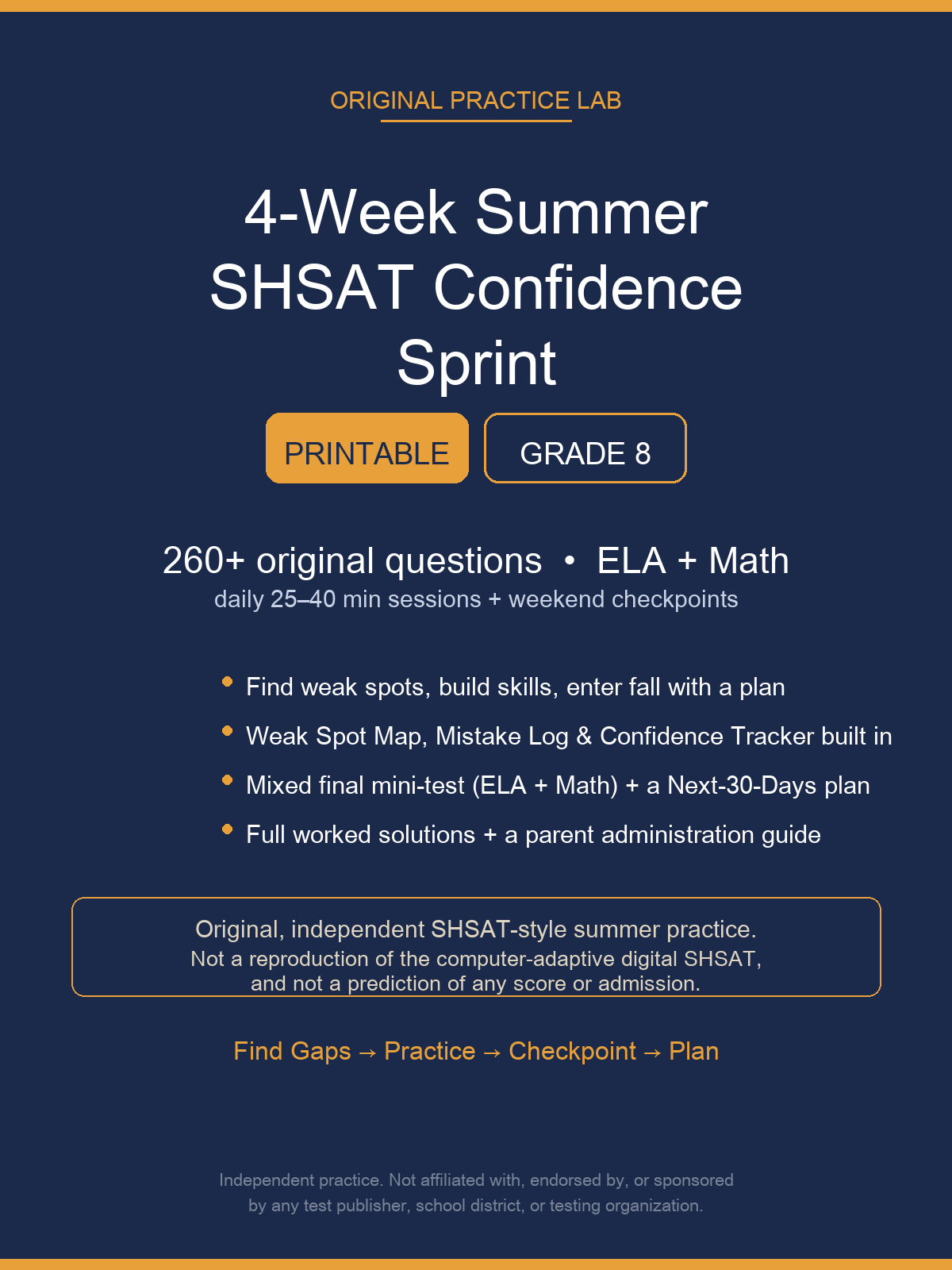
If the results show mixed weakness across ELA and math, or if your family needs a day-by-day plan instead of another pile of worksheets, the 4-Week Summer SHSAT Confidence Sprint is the better next step. It is designed to turn weak spots into short daily practice before fall prep gets crowded.
A Simple 30-Minute Parent Review Routine
Minutes 0-5: record the raw result and mark missed, guessed, and slow questions. Minutes 5-15: sort ELA misses into reading evidence, inference, vocabulary, revising/editing, or stamina. Minutes 15-25: sort math misses into algebra, ratios, geometry, word problems, grid-ins, or careless errors.
Minutes 25-30: choose the next two weak spots and write the next practice step. The point is not to make the parent into a full-time tutor. The point is to make the next week obvious.